
You have probably lived this scene: you explain something perfectly clear (to you!) and the other person understands something else, takes offence, tunes out or gets irritated. You repeat yourself, more slowly, more loudly. Nothing works.
And yet the problem was not what you were saying.
This is exactly the starting point of the Process Communication Model (PCM, sometimes called Process Com or ProcessCom): in communication, the how matters at least as much as the what.
The right message, delivered through the wrong channel, at the wrong moment, to someone whose needs are not being met, will not get through.
I am a certified PCM coach and trainer, and this guide is the one I wish I had read when I started: a complete tour of the model, its origins, its concepts, its uses, its limits… without turning a tool for understanding into a labelling machine!
What is the Process Communication Model?
PCM is both:
- a model for understanding personality, yours and other people's: how each of us perceives the world, what motivates us, what stresses us;
- an operational communication tool: how to concretely adapt the way you say things so that each personality type can hear you, including (and above all) when tension is running high.
What sets it apart from other models?
Where many models describe who you are, PCM focuses first on the process of the exchange: it equips you in real time, sentence by sentence, in the conversation.
It is a model made to be practised, not just known.
Origins: Taibi Kahler, transactional analysis and NASA
The model was developed from the 1970s onwards by Taibi Kahler, an American psychologist with a background in transactional analysis.
His decisive contribution: showing that personality dynamics, and distress sequences in particular, can be identified from observable behaviour, second by second (words, tone, posture), and not only from the content of what is said.
His work on the "miniscript" earned him the Eric Berne Memorial Scientific Award in 1977, named after the founder of transactional analysis.
It is this predictive power that caught NASA's interest.
The space agency drew on Kahler's work for selecting its astronauts and putting crews together. Because in a capsule, under extreme pressure, the question is not whether people are competent, but how they will react under stress and whether they will still be able to communicate.
Since then, the model has spread worldwide: it is now taught in dozens of countries and languages by thousands of certified trainers, coaches and practitioners.
The central concept: the personality condominium
Forget right away the idea that PCM "sorts people into six categories".
The model says exactly the opposite: each of us has all six personality types, developed to varying degrees and stacked in a unique order, like a six-storey condominium whose layout belongs to you alone.
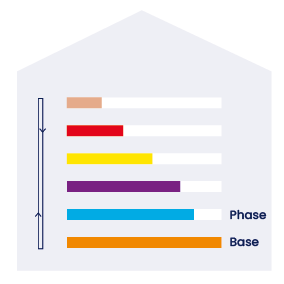
With six floors to arrange, there are 720 possible structures; once you factor in the energy available on each floor, the combinations become endless.
Two notions organise this condominium:
- The Base (the ground floor): your most developed type, which determines how you perceive the world, your natural communication channel and your characteristic strengths. It is your relational "mother tongue".
- The Phase (the floor "in development"), which determines your current psychological needs (your motivational fuel) and your most visible distress sequence. Unlike the Base, the Phase can change over a lifetime, following a period of intense and lasting stress: this is the phase change, which explains why so many people feel they have "changed" at certain turning points in their lives.
→ To go further: Base and Phase in PCM.
The 6 personality types at a glance
Here are the six types:
| Type | Perception of the world | Strengths | Main psychological need |
|---|---|---|---|
| Thinker | Thoughts: facts, logic | Organised, responsible, logical | Recognition of work, time structure |
| Persister | Opinions: values, convictions | Dedicated, observant, conscientious | Recognition of opinions and convictions |
| Harmonizer | Emotions: feelings | Warm, sensitive, compassionate | Recognition of person, sensory needs |
| Imaginer | Reflections: inner imagination | Calm, imaginative, reflective | Solitude |
| Promoter | Actions: here and now | Adaptable, charming, resourceful | Incidence: excitement, challenges |
| Rebel | Reactions: likes / dislikes | Spontaneous, creative, playful | Playful contact |
Two essential points:
- No type is better than another. Each brings specific strengths; a high-performing team is precisely one that combines them.
- Nobody "is" a type: we speak of a person's Base or Phase, in other words the most active floors of their condominium.
→ For a detailed portrait of each: The 6 PCM personality types explained
The components of the model: how PCM equips communication
The richness of PCM lies in the fact that each type is described along several complementary, directly actionable dimensions.
Perceptions
Each type filters the world differently: through thoughts, opinions, emotions, reflections, actions or reactions…
Communication channels
The same content can be offered through a requestive channel (questions and information, focused on rational content), a nurturative channel (focused on the relationship), a directive channel (focused on getting into action) or an emotive, playful channel (focused on the relationship in terms of energy and play). Using the right channel opens the door. Using the wrong one means talking to a wall, even with the best message in the world.
Psychological needs
Everyone's motivational fuel: recognition of work, time structure, recognition of opinions, recognition of person, sensory comfort, solitude, excitement, playful contact… When fed, they produce motivation and availability; when ignored, they trigger distress.
→ Psychological needs: the invisible fuel of motivation.
Preferred environments and interaction styles
Alone or in a group, structured or informal settings, democratic, benevolent, autocratic or laissez-faire style: so many preferences that shed light on management and team composition.
Distress in PCM: the most powerful part of the model
This is probably PCM's most distinctive contribution: a detailed and predictable description of what happens when communication goes off the rails. When their psychological needs are not met, each person goes down a distress sequence in three degrees.
The key idea to remember:
Behaviour under stress is not the person; it is their signal.
The effective response is never to confront the symptom, but to meet the need that is missing.
→ For the full mechanics: The 3 degrees of distress in PCM.
What is PCM used for in practice?
In management and leadership
Adapting the way you delegate, recognise, motivate and set boundaries to each team member. Without changing the objectives, but by changing the process.
In difficult conversations
Feedback, disagreements, sensitive announcements: phrasing things so they are heard, spotting the other person's stress (and your own) and defusing it before it escalates.
In team cohesion
Giving a team a common language to talk about its differences, turning recurring friction into complementarity, and understanding why "so-and-so and so-and-so don't get along": almost always a matter of channels and needs, rarely of ill will.
In coaching and personal development
Understanding your structure, your current drivers of motivation, your distress sequence. Rereading certain turning points in your life in the light of a phase change. Broadening your relational flexibility by learning to "take the elevator" to your upper floors…
In private life
Couples, parenting, friendships: the mechanisms are exactly the same, and this is often where the realisations are strongest.
What PCM is not: my safeguards as a practitioner
Here are the limits I systematically set with my clients.
- It is not a labelling machine.
Six types in everyone, 720 structures, a phase that evolves: the model is built against the single box. If someone "diagnoses" you in ten seconds ("you're such a Promoter"), they are misusing the tool. - It is not a tool for screening candidates.
PCM sheds light on communication and integration; it does not predict performance and must never be used to rule someone out on the strength of a profile. - It is not an instrument of manipulation.
Or rather it is, since all communication is manipulation, of course 😊
Adapting your channel to be understood is consideration. Using the keys of the model against the person's interest is a perversion of it. - It is not therapy.
The model helps understand and prevent relational stress; in case of lasting distress, the right person to talk to is still a health professional. - It is not absolute scientific truth.
Like any typological model, PCM is the subject of academic debate. I use it for what it is: a remarkably practical and effective lens.
How to discover your PCM profile
The entry point is the personality inventory: an online questionnaire whose results are presented during an individual debrief with a certified practitioner.
This personalised document describes your condominium (Base, Phase, order of the floors), your channels, your current needs and your distress sequence, with concrete ideas for everyday life.
The debrief can only be done by a certified PCM coach or trainer.
It is the dialogue that turns percentages into insights, and that prevents misguided self-interpretations.
→ The Process Communication personality inventory
PCM training takes you from self-knowledge to practice: recognising the signals in others, switching channels in real time, feeding needs, defusing distress. It is training in the athletic sense of the word, and it is what I most enjoy passing on.
At Coherence Coaching, we do this regularly with professional teams and leadership committees who want to communicate and collaborate better. Contact us to talk it over…
Note: there are also training courses you can sign up for individually, especially if you want to become a PCM coach or trainer, but we do not offer them at Coherence Coaching.
Frequently asked questions about PCM
PCM, Process Com, ProcessCom: are they the same thing?
Yes, these are names for the same model, whose official name is the Process Communication Model®, a registered trademark.
How long does it take to learn PCM?
The basics can be learned in two to three days of training. Fluency comes with practice, like a language.
Many participants describe a remarkable "before and after", followed by years of going deeper.
How is it different from MBTI or DISC?
In short: MBTI excels at introspection, DISC at a quick common language, and PCM at real-time communication and stress management.
Full article coming soon: PCM, MBTI, DISC: which model should you choose?
Can my profile change if I retake the inventory in ten years?
Your Base will stay the same.
Your Phase, on the other hand, may have changed: that is actually one of the great benefits of taking stock again after a turning point in life.
Does PCM work across all cultures?
The model is taught in dozens of countries and languages. The types express themselves with cultural nuances, but the underlying mechanisms (perceptions, needs, distress…) are found everywhere.