
"Now I finally understand what happened. Early in my career, I was completely focused on work; today, and it's probably linked to the fact that I now have children, what really motivates me is my connection with people. Is that what a phase change is?"
I hear this kind of question regularly during personality inventory debriefs or in PCM training.
And it touches on what, to my mind, gives the Process Communication Model all its elegance: the distinction between Base and Phase.
This is the concept that allows PCM to escape the classic criticism levelled at personality models: putting people in boxes.
Because it models precisely what boxes cannot: the fact that we evolve.
In this article, I invite you to understand why you are not one personality type but a unique combination of all six, what is stable in you and what moves, and what that famous "phase change" means, the one that explains so many turning points in life.
The condominium: you are all six types at once
Let's start by putting an end to a common misconception: in PCM, nobody "is" a Thinker, a Harmonizer or a Promoter.
Each of us has all six personality types (Thinker, Persister, Harmonizer, Imaginer, Promoter, Rebel), developed to varying degrees and stacked in an order of our own.
The model's emblematic metaphor is the condominium.
Imagine a six-storey building: each floor corresponds to a personality type, and the area of each floor represents the amount of energy you have available to draw on that type's resources.
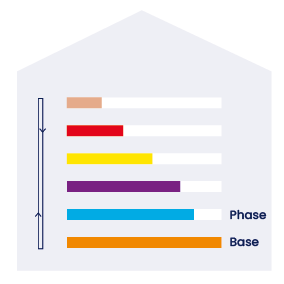
With six floors to arrange, there are 720 possible combinations, and if you factor in the energy available on each floor, the number of profiles becomes endless.
That is why two people "with a Harmonizer Base" can be very different from each other.
In everyday life, you move around your condominium as if in an elevator.
Faced with a person or a situation that calls on an upper floor of your structure, you can go up there, but staying there for long uses up adaptation energy.
The higher the floor in your condominium, the less developed it is, and the more costly the stay.
The Base: your relational mother tongue
The ground floor of your condominium is your Base: your most developed personality type. According to Taibi Kahler, it is set in childhood, around the age of six or seven, and does not change afterwards.
The Base determines the most stable aspects of the way you relate to others:
- Your perception: the main filter through which you connect with the world. Through factual thoughts, opinions, emotions, reflections, actions or spontaneous reactions.
- Your preferred communication channel: the way you naturally express yourself and the way you best hear others.
- Your characteristic strengths and your preferred interaction style.
In a way, the Base is your mother tongue.
Whatever languages you learn later, it is the one you think in, the one that comes back when you are tired, the one that takes no effort.
You can become perfectly "multilingual" in relationships (that is the whole point of PCM training), but your mother tongue remains your home port.
The Phase: your current driving force
Now for the concept that changes everything: the Phase.
It is the floor of your condominium currently "in development", the one that determines two essential things in your present life:
- Your current psychological needs: the fuel you need today to be motivated and on form.
- Your most visible distress sequence: the way you malfunction when that fuel runs low.
At the outset, Base and Phase coincide: we are born, so to speak, in phase with our Base.
But sometimes, over the course of a life, the Phase can move to another floor.
This is the concept of the phase change.
In practice, this means that a person with a Thinker Base may today be in a Harmonizer Phase: they still perceive the world through factual thinking and communicate in a structured way (their Base).
But what mainly motivates them now is being recognised and appreciated as a person.
That is why so many people feel they have "changed personality": the structure has not moved, but the engine has.
The phase change: when life takes us up a floor
How does a phase change happen?
According to the model, it occurs after intense and lasting stress, most often linked to an existential issue specific to the current phase, which the person eventually works through. This can be an ordeal (bereavement, separation, burnout) or a major positive transformation (becoming a parent, a chosen change of life).
Three important points to properly understand the phase change:
- It is neither compulsory nor something you can plan.
Some people keep the same phase all their lives while others move through one or several floors. There is no delay and no merit in this: no path is better than another. - You go up, you don't come back down.
The phase change follows the order of the floors in your condominium. Each phase you have been through remains an acquired resource: you know its needs and codes from the inside. Even if the issue of a past phase sometimes comes back like an "elastic band". - A phase change is not a crisis, even if it looks like one.
It is often in hindsight, during a debrief, that people reread a difficult period of their life as the move from one floor to another. That rereading is frequently a huge relief: "I wasn't malfunctioning, I was changing."
Why the Base / Phase distinction is valuable (and anti-label)
The Base/Phase distinction is not a theoretical subtlety: it has very concrete consequences.
- To know yourself better
Your PCM personality inventory does not stick a label on you; it takes a snapshot of a structure and a dynamic. It explains both what has always been true of you (Base) and what drives you right now (Phase).
- To communicate
To communicate well with someone, you connect through their Base (their perception, their channel), and you motivate them through their Phase (their current needs).
- To support others
In coaching, knowing that a client may be going through a phase change transforms how you read their situation. What looks like losing one's bearings is sometimes a deep renegotiation of what drives them.
- To reject boxes, with arguments
When someone tells me "PCM is just another thing that puts people in boxes", the answer comes down to three facts: six types in everyone, 720 possible structures, and a phase that can evolve throughout life. Not much of a "box"…
In practice: three questions to ask yourself
- What has never changed about me?
My spontaneous way of making contact, my perception filter, my lifelong strengths… These are clues to identify your Base. - What fuels me right now?
What I need today to feel good, which may not have been my driving force ten years ago… These are clues to identify your Phase. - Was there a pivotal period?
A time when my deepest priorities shifted, often after a period of intense stress: that is the clue to a possible phase change.
These questions open up reflection, but only a personality inventory debriefed with a certified practitioner will allow you to reliably establish your structure.
Frequently asked questions about Base and Phase in the PCM model
Can you have two Bases?
No: the structure ranks the six types, and only one occupies the ground floor.
However, a very developed second floor can give the impression of a "double dominant".
Can a phase change happen more than once?
Yes. Some people never change phase, others go through several phases over their lifetime, at the pace of their own story.
There is no right or wrong, and no life path is worth more than another.
How can I tell whether I am going through a phase change or "just" a period of stress?
This is precisely one of the subtlest questions in the model, and it deserves support: from the outside, the two look alike.
The difference lies in the duration, the intensity and the issue being worked through.
It is an excellent topic to explore in a debrief or in coaching.
Is the Base being set at age 6 or 7 scientifically proven?
It is the model's premise, based on Taibi Kahler's clinical observations, and it is one of the points debated academically, as with any psychological model.
For me, the value of the concept is measured by its power to shed light on experience and guide action in the field, within a coaching framework, not a diagnostic one.